“Change follows change in us, almost without transition; we pass from blissful rapture to sobbing woe; a single step divides our sublimest ecstasies from the darkest depth of spiritual despondency.” — Ignacy Jan Paderewski.
Every Journey Starts with a Step
Paderewski’s quote has connected with me for years because life can change in a single heartbeat. With little or no warning, we can move from incredible joy to incredible pain, from feeling like we have everything figured out to suddenly wondering how we became so lost.
The part of the quote that hits me the hardest is, “a single step divides…” I often think about how the distance between strength and struggle, joy and sorrow, or hope and despair can come down to a single step. If what we carry can change in a heartbeat, why do we hold on to it so tightly? And maybe the harder question is, how do we let it go?
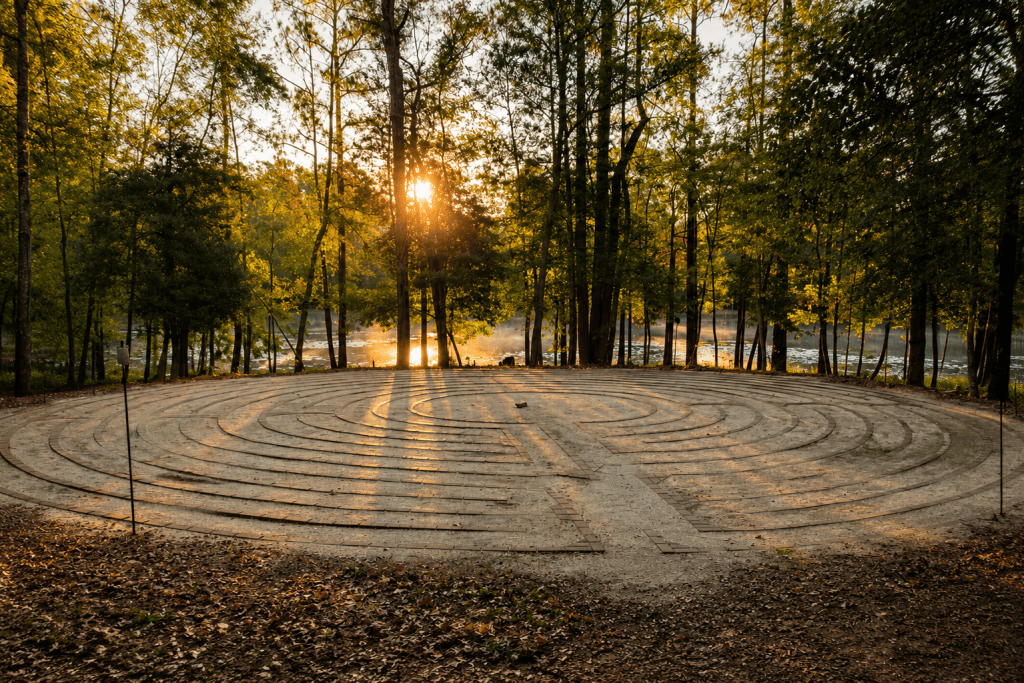
One way I have found to release some of life’s burdens is to walk a labyrinth. A labyrinth is simple: there is one path in and the same path back out. There are no shortcuts, no dead ends, and no decisions about which way to turn. You keep walking.
What makes a labyrinth unique is that there is no right or wrong way to walk it. Some walks have brought me clarity, while others have left me with more questions than answers. Sometimes I have walked with a specific purpose, and other times I have walked onto the path without knowing what I was looking for. The labyrinth doesn’t tell you what you’re supposed to find along the way. You must be willing to walk it.
You follow the winding path toward the center, but somewhere along the way, the walk becomes less about where your feet are taking you and more about what you are carrying with you. Even when you reach the center, the journey isn’t over. Eventually, you must turn around and walk back out.
In a lot of ways, that feels like life to me. We spend years trying to find our way, only to discover that sometimes the real journey is inward. The question isn’t simply whether we can find our way back out, but what we are willing to leave behind, and what we choose to carry with us when we do.
The Weight I Carried
I know I am not the only warrior, military or first responder, who has struggled with the belief that somehow letting go of the pain means letting go of what it represents.
If I let go of the guilt, I might forget the names and faces of those warriors lost. If I forgive myself, maybe I’m letting myself off the hook. If I stop hurting, maybe what happened, or the people connected to those memories, won’t matter as much.
That weight didn’t come from a single moment or experience. It was built over my entire lifetime. From my time in combat to my time supporting Port Mortuary operations, and everything in between, I came to understand some of it. Some of it I buried. And some of it I kept for so long that I stopped realizing just how heavy it had become.
There was grief for not only people I’ve lost, but pieces of my past, and sides of myself that aren’t coming back. There was survivor’s guilt, the question of why I got to keep walking when others didn’t, and whether moving forward somehow meant leaving them behind. There was also regret. The things I wish I’d said differently or shouldn’t have said, and numerous times I wish I’d been more present.
My inability to let go eventually led me to the night I almost ended it all. The weight I carried had reached a point where I didn’t know how much longer I could go on. I had reached a tipping point where I had to ask myself a hard question: Can I shed some of the weight without sacrificing the people, the memories, and the parts of my life that matter to me?
Release
Standing at the entrance of the labyrinth, I tried to make sense of the noise in my head. I thought about what I needed to let go of, including the night I almost ended everything. I tried so hard to forget, but now I struggle to remember.
Before forcing myself to take that first step, I looked down and picked up a large stone. It represented the grief, anger, guilt, fear, regret, and memories I had been carrying from a lifetime of struggle.
Over time, I learned that a labyrinth walk has three parts: release, receive, and return. Walking in is about release, acknowledging what you are carrying as you make your way toward the center. The center is about receiving, a place to stop, be still, listen, pray, reflect, or simply be present. Then comes the walk back out, the return, when you leave behind what you are ready to release and consider what you want to carry forward instead.
With the stone in my hand, I tentatively started my labyrinth walk, looking straight down at the path. I felt the ground beneath my feet as a slight breeze whispered through the trees and the late-afternoon sun heated the path. Keep walking, I thought.
Walking slowly enough to hear myself breathe, I tried to remain in the moment. When my mind wandered, I reminded myself to trust the path and keep moving toward the center. The farther I walked, the less I noticed the actual path and the more I focused on the stone and what it represented. As my breathing slowed, so did my pace, but regret kept creeping into my thoughts.
Why does a man like me deserve to live? I’ve got scars from battles I couldn’t win and regrets I can’t undo. Some days, I still feel like a walking wreck, wanting grace and one more chance before my final story is told.
As I neared the center, fear replaced those thoughts. Could I enter the center? And if I entered, could I actually release the burdens I had been carrying?
Receive
I finally reached the center. Before crossing the center’s threshold, I stopped, closed my eyes, and took several deep breaths. Standing there, I thought about what I was told the first time I ever journeyed into a labyrinth. The center is a sacred space where one’s self becomes both the traveler and the destination—a space where the individual becomes still enough to receive.
For me, I always thought I was supposed to receive something tangible. But I finally realized I was supposed to receive stillness and accept whatever that looked like: peace, clarity, silence, forgiveness, or even something I couldn’t put into words.
It was at that moment that I opened my eyes and entered the center. This is where I struggle to find the words. I wish I could describe some magical epiphany or explain exactly what happened inside me, but I can’t. It wasn’t happiness or sadness. It wasn’t even relief, at least not in the way I understand relief.
It was something more significant than that.
For a few moments, I just stood there holding the stone I had carried with me. The grief, anger, guilt, fear, regret, and memories were all represented by that stone. Everything I had bottled up over a lifetime was right there in my hand. And yet, something had changed.
I didn’t hear a voice or suddenly have all the answers. Nothing around me was different, but something in me was. I figure some experiences aren’t supposed to be explained, and maybe trying to put words around my time in the center would make it smaller than it really was.
All I know is that the man who stood in the center of that labyrinth was not holding the stone the same way as the man who had picked it up at the entrance.
At that point, I dropped the stone and began my trek home.
Return
Stepping out of the center, I began the walk back. I was on the same path that had brought me there, only now I was walking it in the opposite direction. The labyrinth had not changed. The path hadn’t changed. Yet something had. Me.
As my journey continued, it felt as if I was going home. A distinct shift ran through my body, mind, and spirit. Emotionally, I felt unburdened. Mentally, I felt clear but exhausted. The closer I walked toward the exit, the more I felt the weight I had carried into the labyrinth slip away. For the moment, the voices in my head had quieted, replaced by a sense of calm. I had come into the labyrinth carrying so much, and now I was beginning to understand that I did not have to pick it all back up on the way out.
My eyes were no longer focused on the path underneath my feet. I was walking taller now, my head up, enjoying the sun on my face. My breathing was calm and matched the slow pace of my steps. And somewhere along that walk out, I realized something about the night I almost ended everything. The recollection of that night would always be part of my story, but the burden of it was no longer mine to carry.
The Step Forward
Every journey starts with a single step. But my journey to the labyrinth’s center and back does not mean everything within me is fixed. Now I must decide how I will live when I step beyond the labyrinth.
The book The Wild Edge of Sorrow by Francis Weller showed me a new way to look at life. Weller wrote about the importance of learning to live alongside grief rather than spending our lives trying to outrun it.
Maybe that is what this walk finally taught me. I do not have to forget the people I’ve lost, erase the things I have seen, or pretend the painful parts of my story never happened. My past will always be part of my story, but I don’t have to carry its weight.
I entered the labyrinth believing that letting go meant leaving something behind. But I walked out realizing that letting go often means choosing not to carry our burdens the same way anymore. And maybe Paderewski was right after all. Sometimes, a single step really does divide one life from another.
So, I’ll leave you with a challenge.
What are you still carrying simply because you have convinced yourself that putting it down would somehow diminish what it meant?
Maybe it’s grief. Guilt. Anger. Regret. A mistake you made twenty years ago. Something someone did to you. Or maybe it is a version of yourself you’ve been trying desperately to hold on to.
I’m not asking you to forget it. I’m not asking you to pretend it didn’t happen. I’m simply asking you to consider whether you still need to carry its weight.
Because sooner or later, we all must decide what we are willing to leave behind and what we will carry forward.
And sometimes, that decision begins with a single step.
Until next time, struggle well, my friends. And remember, struggle is a terrible thing to waste. Let it become part of your story, but never the end of it.
~ Grim


Did this resonate with you? I’d love to hear your thoughts.