The most brutal battles aren’t fought on the battlefield or the job — they’re fought in the silence after, when no one’s watching, and the storm inside won’t quit.
Life doesn’t always send warning shots. Sometimes the storm drops on you without mercy. Other times, you see it building on the horizon, dark and heavy, and your gut already knows it’s coming. Veterans, first responders, and their families are well aware of this truth. Our storms are different. They’re invisible to the rest of the world, but they rage just as fiercely.
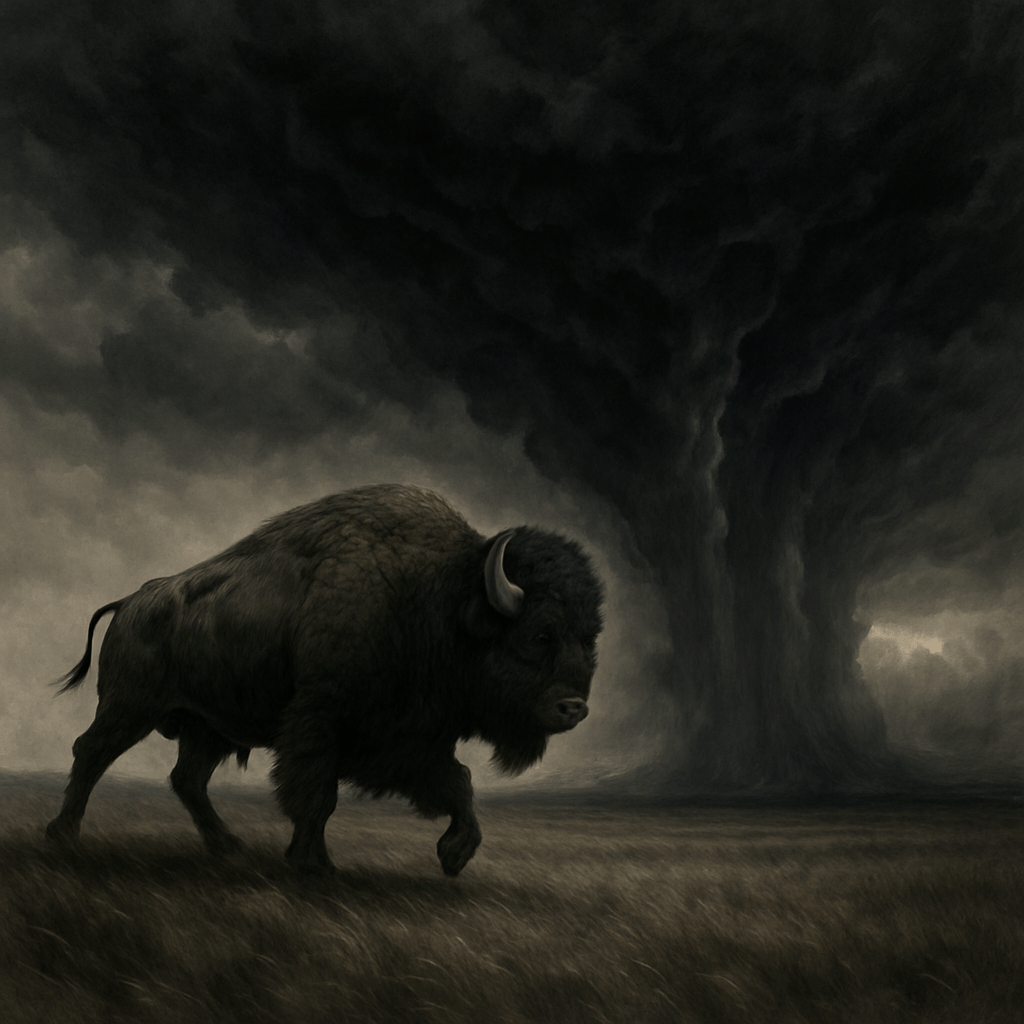
Out on the plains, when a storm rolls in, cows and buffalo respond in opposite ways. Cows run from the storm. It seems logical — get away from the danger, avoid the chaos. But the storm is faster. By running from it, cows end up stuck in the downpour longer, suffering more. Buffalo does the opposite. They turn and run into the storm. They take the hit head-on, moving through it quicker and reaching clear skies sooner.
That lesson has stayed with me because it’s the same choice we face when life’s storms come. We can run like cows, numbing ourselves, avoiding the pain, trying to outrun what we don’t want to face. Or we can live like buffalo, turning toward the storm, facing it with courage, and pushing through to the other side. One path drags out the pain. The other shortens it — even though it’s harder in the moment.
I’ve lived both sides of that choice. One of the heaviest storms I’ve carried is survivor’s guilt. I walked away from situations where others didn’t. Brothers and sisters I trusted with my life never made it home. Some of them were closer than family — we laughed together, suffered together, and carried each other through hell. Out there, trust wasn’t optional. It was survival. And when they didn’t come back, the question dug into me: why them and not me?
For a long time, that guilt followed me like a shadow. It followed me into the quiet hours, when there were no distractions left to hide behind. I replayed every moment, every decision, every mission, wondering if I could have done something different. I carried their names in my heart, but let the weight of their loss crush me instead of lift me.
Like the cow, I tried to outrun it. I buried myself in work. I numbed myself with noise. I wore the mask that said, “I’m fine,” even when I wasn’t. But guilt doesn’t let go when you run from it. It tightens its grip. It grows heavier.
It wasn’t until I started facing it — like the buffalo — that things began to shift. For me, it started with my time at Warrior PATHH, sitting with like-minded warriors and saying the names of my lost brothers and sisters out loud. Telling the stories I had locked away. Allowing myself to cry for them, to rage for them, to admit I was still carrying them. And in that space, I realized something: the guilt didn’t honor them. Living did. Every day I wake up is a chance to carry forward their legacy, to live in a way that reflects their courage and sacrifice.
Survivor’s guilt didn’t vanish. It never will. But it no longer owns me. By facing the storm, I learned to carry their memory with honor, not in chains.
The Other Storms We Face
Survivor’s guilt is only one storm. There are more storms that veterans and first responders know all too well:
- Constantly scanning the room, watching exits, sitting with your back to the wall. Useful in the fight. Exhausting in everyday life.
- The long shifts, the endless calls, the paperwork, the bureaucracy — it grinds down even the strongest. You end up running on fumes and wondering when the spark will come back.
- Moral injury. Doing everything you could and still not being able to save those who died. Carrying decisions made in split seconds that the world will never understand.
- The family toll. Missing birthdays. Coming home physically but staying mentally on the battlefield or the job. Your spouse and kids feel the storm even if they can’t name it.
- Feeling like no one outside the uniform gets it. That sense you’re carrying a weight too heavy to explain.
- These are real storms. Left unchecked, they eat us alive. Run from them, and they’ll run you down. Face them, and you can move through to the other side.
Practices for Weathering the Storm
Survivor’s guilt taught me something: you can’t outrun what’s inside you. You have to face it, and you have to use practices that keep you steady when the storm hits. These are the practices that helped me — the same ones I lean on when new storms roll in:
- Ground in the Breath. Box breathing (in 4, hold 4, out 4, hold 4) gave me footing when my mind was spiraling.
- Lean on Your Tribe. Speaking the storm out loud with brothers and sisters who understood loosened its grip.
- Embrace the Suck on Purpose. Cold showers, journaling truths I didn’t want to face, long rucks — these small storms built resilience for the big ones.
- Anchor in Purpose. Shifting from “why me?” to “how do I honor them?” gave me a compass when everything felt chaotic.
- Seek Shelter When Needed. Therapy, faith, peer programs — not weakness. Shelter is what lets you recharge for the fight ahead.
The storms never stop coming. But if we meet them like buffalo, we move through them quicker, with less wasted suffering, and we come out stronger on the other side.
Storms test us. They strip away the easy answers and force us to choose — run or face them. And when you’ve faced enough storms, you start to realize something: the very thing that feels like it’s standing in your way is often the thing that shapes you most. That truth isn’t new. Warriors through history have carried it, and one of the clearest modern voices putting it into words is Ryan Holiday in his book, The Obstacle Is the Way.
It draws on ancient Stoic wisdom, the idea that obstacles aren’t just barriers to endure — they’re the path itself. Holiday writes: “The impediment to action advances action. What stands in the way becomes the way.” That’s buffalo wisdom. The storm isn’t just something to survive; it’s the very thing that makes us stronger, sharper, and more capable on the other side.
It’s not about pretending the pain isn’t real. It’s about refusing to let pain be wasted. The obstacle, the trauma, the guilt, the burnout — they’re not detours. They’re the road. And like the buffalo, the way forward isn’t around them. It’s through them.
Being the buffalo doesn’t mean the storm won’t hurt. It doesn’t mean you won’t feel guilt, grief, or anger. It means you refuse to let the storm define you. You run into it — with courage, with purpose, and with your herd beside you.
If you’re carrying survivor’s guilt, I’ll tell you this: you’re not alone. You’re not broken. The storm is real — but so is your strength. Running from it will only prolong the issue. Facing it head-on, with your practices, with your tribe, and with purpose, is how you break through.
So, here’s the challenge: stop running. Turn and face the storm. Be the buffalo. Because on this path of healing, we don’t run alone. We charge forward together — and we honor the ones we’ve lost by the way we live.
Until next time, struggle well my friends, and remember, you are never alone!
~Grim



Leave a reply to Grim Cancel reply